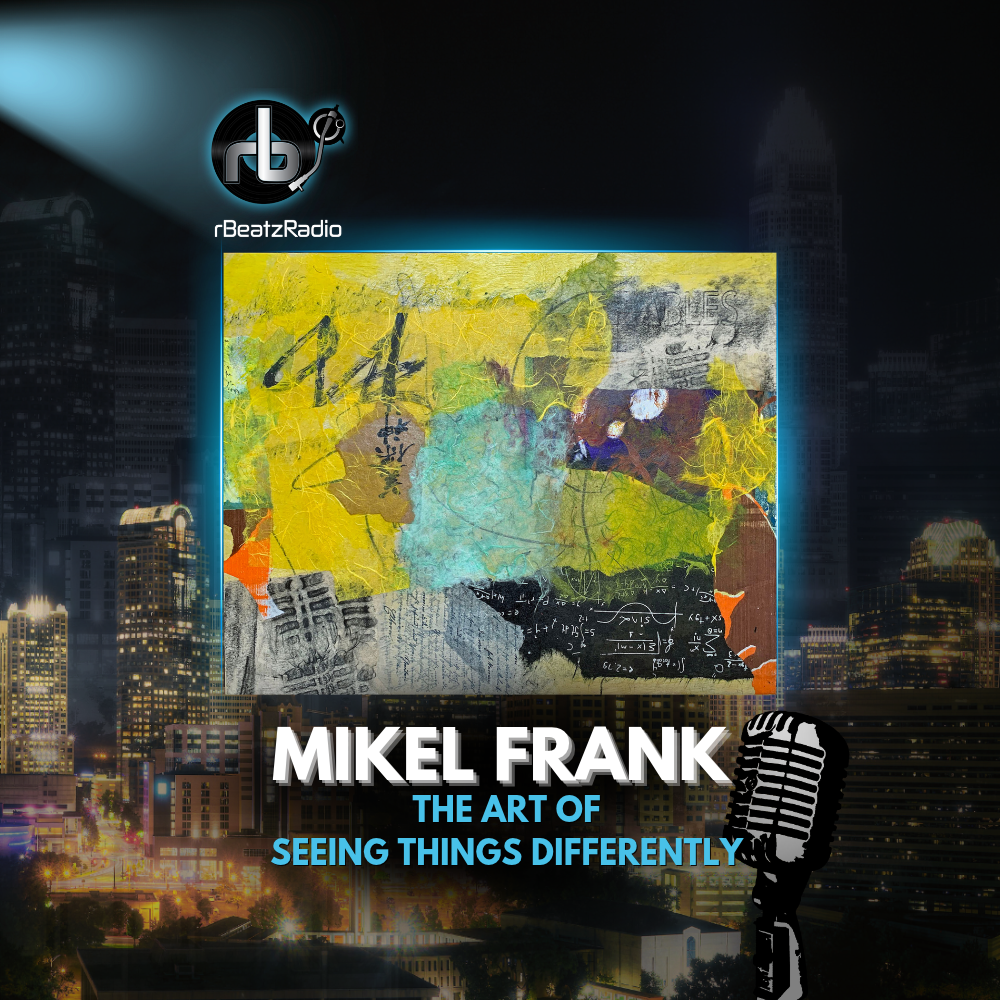
Mixed-Media Art and the Creative Possibilities of Found Materials
Mikel Frank joins Terry Hudson on Oui Talk Raw for a grounded conversation about art, collaboration, and community. A Charlotte-based artist, curator, educator, and arts advocate, Mikel works across mixed-media collage, painting, and abstraction. His perspective has been shaped by his studies at MICA and Pratt Institute and a 29-year tenure at The Metropolitan Museum of Art. He shares how found materials and creative risk-taking shape his practice, reflects on collaborative projects including Christo and Jeanne-Claude’s The Gates, and talks about curating, teaching, and supporting artists in Charlotte. The conversation also touches on his work with the Guild of Charlotte Artists and the Contemporary Artists Forum, along with several upcoming exhibitions and arts events.
Mikel Frank’s Exhibitions, Artist Talks, and Upcoming Events
Mikel Frank
Key Takeaways
- Art begins with learning how to see. Mikel’s interest in art was shaped early by watching different artists interpret the same subject in completely different ways.
- An artist’s work represents a lifetime of experience. Mikel explains why a painting cannot always be measured by how long it took to make.
- Abstract art creates room for personal expression. His artistic direction developed through exposure to artists and teachers who helped him move beyond traditional representation.
- Working behind the scenes can open unexpected doors. Mikel’s technical production experience helped lead him to a long career at the Metropolitan Museum of Art.
- Big public art projects require imagination and collaboration. His experience with Christo and Jeanne-Claude’s The Gates offered a firsthand look at the work behind ambitious installations.
- Charlotte’s creative community grows through shared effort. Mikel discusses the people, spaces, organizations, and opportunities that help artists connect.
- Artists need more than talent. Networking, communication, promotion, and being willing to participate all matter.
- Showing up can lead to opportunities you did not expect. Mikel encourages emerging artists to stay open and not turn down every opportunity.
- Art can help define a city’s identity. Terry and Mikel explore the value of bringing artists, musicians, performers, and businesses into the same conversation.
Mikel Frank on Art, Creativity, and Building Charlotte’s Arts Community
Art is about more than what you see on a canvas. It is about how you look at the world, what you bring to your work, and the connections you make along the way. In this episode of Oui Talk Raw, Terry Hudson sits down with artist, curator, educator, and arts advocate Mikel Frank for a thoughtful conversation about creativity, artistic expression, the people who shape a community, and the importance of showing up.
Mikel shares stories from his nearly three decades working at the Metropolitan Museum of Art, his experiences with influential artists and large-scale public art projects, and his commitment to helping Charlotte’s creative community grow. Along the way, Terry brings his familiar curiosity and connector’s perspective, exploring how art, music, culture, and collaboration can help shape a city.
Mikel Frank’s Journey: From a Childhood Art Lesson to the Metropolitan Museum of Art
Mikel’s relationship with art began when he was around 10 years old. His mother was taking painting classes and volunteered him as a subject for the class. He sat for several artists, each of whom created a completely different interpretation of the same person. That experience stayed with him. It showed him that art was not simply about reproducing what was in front of you; it was about seeing something through your own eyes and expressing it from the heart.
Terry recognizes the importance of that early moment, connecting Mikel’s story to the origin stories he often uses when speaking with others. For both of them, the conversation comes back to how individual experience shapes the way a person sees the world.
Mikel also challenges the way people sometimes approach artwork. One question artists regularly hear is how long a piece took to create. For him, that question misses the years of learning, looking, experimenting, and living that go into making it. He explains that an artwork is the result of a much longer process than the time spent physically putting paint on a surface.
As Mikel puts it, “I think it’s always an individual vision that people have.”
He encourages people to slow down and pay attention to the world around them. Nature, light, shapes, and everyday surroundings offer endless inspiration, but people can miss those details when they move through life without really looking.
How the Metropolitan Museum of Art Shaped His Career
After earning his BFA from the Maryland Institute College of Art and his MFA from Pratt Institute, Mikel took a media course and earned a certificate in audio engineering. Those technical skills helped him land a position in the concerts and lectures department at the Metropolitan Museum of Art in New York.
What began as a practical decision to build a career and support a family became a 29-year chapter of his life. His work involved production, staging, projection, lighting, and the many details required to bring museum programs and events to life. Some weeks reached 70 hours, but he still found ways to keep painting, often fitting his art into weekends and whatever time he could find.
The Met also brought Mikel into contact with remarkable artists and performers. He shares stories from those years, including meeting his personal hero, artist Robert Rauschenberg, after Rauschenberg had suffered a stroke. Mikel describes that encounter as one of the most meaningful experiences of his life.
There are lighter memories, too. He recalls an exchange with pianist Till Fellner, sharing a line from The Big Lebowskiafter a performance. It is a small story, but it captures the humor and personality that run through Mikel’s recollections.
Why Mikel Frank Chose Abstract Art
Mikel learned traditional drawing and rendering, but it never fully connected with him. During his time at the Maryland Institute, his teacher Barry Nemet encouraged him to look at the work of Paul Klee. That introduction opened the door to other artists, including Kandinsky and the abstract expressionists.
He was also influenced by the energy and visual language of artists such as Jean-Michel Basquiat and Keith Haring. Rather than trying to impress viewers with how accurately he could draw or paint, Mikel wanted to create work that felt personal and emotionally honest.
His mixed-media abstract paintings often bring recognizable images or figures into conversation with surrounding abstraction. He enjoys creating a sense of depth and movement, sometimes placing a figure with their back to the viewer, looking into a space filled with layered forms and imagery.
For Mikel, abstraction provides freedom. It allows him to make connections between images, memories, and feelings without having to explain everything literally.
The Business Side of Being an Artist
Terry and Mikel also discuss something that applies across creative industries: talent alone does not always bring an artist the opportunities they want.
Mikel learned that artists need to understand the work surrounding the work. Marketing, public relations, sales, networking, and building relationships all play a part in getting art seen. He compares this to musicians who may expect that simply posting a song online will lead to discovery. Putting the work out there matters, but artists also have to be intentional about creating opportunities and connecting with people.
It is an especially useful part of the conversation because both Terry and Mikel understand the creative process as well as the business realities that surround it.
Behind the Scenes of Christo and Jeanne-Claude’s The Gates
One of the most fascinating parts of Mikel’s story is his involvement with Christo and Jeanne-Claude’s large-scale public art project, The Gates, in New York City’s Central Park in 2005.
Mikel first encountered the artists through his work at the Met, where they came to give a lecture. He remembers Jeanne-Claude sitting in the audience with a microphone, occasionally correcting Christo during his presentation. The story gives a glimpse of their relationship and the way they worked together.
Later, Mikel had the opportunity to join a crew helping install The Gates. The project involved saffron-colored fabric structures placed along Central Park pathways. Mikel worked with a small group of people, helping position and secure the heavy bases and install the structures. He remembers the scale of the undertaking and the collaboration required to bring the vision to life.
For him, the experience was about more than the finished installation. It was about being part of a group of people working toward the same creative goal.
How Christo and Jeanne-Claude Funded Their Projects
Terry uses the story of The Gates to open a broader discussion about how artists can finance ambitious projects. He points out that artists cannot depend entirely on grants or public funding. Corporate sponsorships, private support, sales, and other creative approaches can also help make large ideas possible.
Mikel explains that Christo and Jeanne-Claude did not accept public funding for their projects. They found ways to finance the work themselves, including selling Christo’s preparatory drawings. The drawings were not simply documentation; they were valuable works in their own right and helped support the projects.
Another detail Mikel appreciates is what happened after an installation came down. The materials could be recycled and used in later projects, and the site would be restored. The temporary nature of the work was part of its identity.
Mikel also discusses the risks involved in large public installations, including the tragic accident connected to the Umbrella Project. He recalls other projects, including Valley Curtain in Colorado, and a proposed river installation that faced environmental concerns.
The stories reveal the ambition, logistics, funding, risk, and teamwork behind work that audiences may only experience for a short time.
Collaboration, Creativity, and the Work of Gerard Amsalem
Mikel’s interest in collaboration continued beyond The Gates. He spent about 10 years creating work alongside French painter and filmmaker Gerard Amsalem.
Their relationship began after they met at an exhibition in New Jersey. They connected through conversations about personal loss, including the deaths of Mikel’s father and Gerard’s brother. That shared experience helped establish a friendship that eventually developed into an artistic partnership.
Their early collaborations started small, but they gradually moved toward larger work. Mikel describes Gerard as the idea person who often imagined what they could do, while Mikel helped bring those ideas into physical form.
They created approximately 20 collaborative works, including pieces made on hollow-core doors and large-scale paintings. Their partnership became another way for Mikel to explore how different creative perspectives could come together.
During COVID, the two also organized a Zoom invitational focused on masters of painting. They discussed artists such as Van Gogh, Picasso, and Monet, along with The Gates and other subjects. It gave people an opportunity to connect around art at a time when in-person gatherings were limited.
VAPA: Creating a Home for Charlotte’s Creative Community
The conversation then turns to one of the places that has become central to Mikel’s life in Charlotte: VAPA.
Mikel talks about the people who helped bring the space together, including Joanne and Arthur Rogers. The former Hal Marshall Building had to be cleared out before it could become a creative destination. Mikel recalls the enormous effort involved, including removing discarded materials and preparing the building for its next chapter.
The result is a large creative space with galleries, artist studios, event rooms, recording facilities, and other businesses and creative services. Mikel has a studio there and is involved with the curation committee for the lower level.
For him, VAPA is more than a place to work. It is a community where artists can meet, exhibit, collaborate, and find new ways to connect with audiences.
He describes it as a second home, perhaps even his first home. That feeling comes through as he talks about the people who make the space what it is.
Galleries, Open Studios, and the VAPA Night Market
Mikel discusses the different activities that bring people into the building, including gallery exhibitions, studio visits, and community events. Open Studio Day takes place on the first Saturday, while the Night Market happens on the second Saturday.
The Night Market has become a popular destination, creating opportunities for artists to show and sell their work while bringing visitors into the space. Mikel credits the support of the community and sponsors, including TD Bank, as part of what helped the event grow.
The larger point is that creative spaces need more than rooms and walls. They need people who are willing to participate, support one another, and keep inviting the community in.
Supporting Artists Through Charlotte’s Museums and Arts Organizations
Mikel’s involvement in Charlotte extends beyond VAPA. He has also been connected to the Mint Museum, where he served as a docent for several years. His interest in art history and his experience studying artists’ work helped him connect with museum audiences.
He discusses the value of the Mint’s relationship with local artists, including a pop-up art market at the Mint’s Randolph location that brought together around 70 artists and vendors and attracted thousands of visitors.
Mikel also talks about moderating artist conversations and panels at VAPA. These discussions give artists an opportunity to talk about their work, their experiences, and the challenges of building a creative life. Rather than treating the conversations as rigid presentations, Mikel enjoys allowing them to develop naturally.
The Guild of Charlotte Artists
Another important part of Mikel’s Charlotte experience is the Guild of Charlotte Artists, one of the city’s longstanding arts organizations. The Guild began in the late 1930s with a small group of women and has grown to approximately 550 members.
Mikel served as president and remains enthusiastic about the organization’s role in bringing artists together. He discusses the importance of membership, fundraising, development, and partnerships that allow the Guild to keep serving the local arts community.
He also describes a Guild exhibition at VAPA that featured 85 artists at the time of the recording. The turnout at Guild events is one of the things Terry has noticed firsthand, describing recent gatherings as packed.
More Places to Discover Charlotte Artists
Mikel and Terry mention several other galleries and creative spaces that contribute to the region’s arts scene, including Charlotte Studio Artists, Queen City Art, Preston Gallery in Monroe, Gallery 51 at The Vue, Loom Gallery and Workspace in Fort Mill, and Spark House on North Tryon.
They discuss how these spaces give artists different ways to show their work, connect with other creatives, and reach people who might not otherwise encounter their art.
The conversation makes clear that Charlotte’s arts community is not limited to one building or organization. It is made up of people and spaces that support one another across the region.
Terry Hudson and Mikel Frank on Connecting Art, Music, and Business
One of the strongest themes in this episode is the importance of bringing creative communities together.
Terry talks about his own role as a connector, helping musicians meet artists, dancers meet filmmakers, photographers connect with poets, and creative people build relationships with business leaders. He sees those connections as part of how Charlotte can develop a stronger identity beyond its reputation as a banking center.
Mikel agrees that the business community needs to understand how the arts contribute to a city, while artists need to recognize how business relationships can help them become more visible and supported.
It is a conversation that reflects both men’s experience. Mikel has spent years building relationships through museums, galleries, collaborations, and arts organizations. Terry brings his perspective as a host, speaker, and connector who wants to help people discover one another.
Terry describes himself as a “dream maker,” but then offers a more fitting description: a “dream facilitator.” It is a revealing moment because the goal is not to take credit for someone else’s vision. It is to help create the conditions where people can meet, work together, and move their ideas forward.
Mikel Frank’s Advice to Emerging Artists: Show Up and Stay Open
When Terry asks what advice Mikel would give a new artist, his answer is direct and practical. He encourages artists to work hard, show up, and remain open to opportunities—even when they are not sure where those opportunities might lead.
Mikel recognizes that not every opportunity will be the right one. But sometimes an experience that seems small or unrelated can lead to something much bigger. He uses his own experience joining Terry’s show as an example. He had never imagined himself doing that kind of work, but accepting the invitation led to new connections and experiences.
His advice is simple:
“show up, work hard, and don’t, this is a sensitive issue because I do it too much, don’t say no to an opportunity.”
That message fits the broader conversation about building a creative life. Artists need to keep making work, but they also need to be present in their communities, meet people, take part in events, and remain curious about what might come next.
What Mikel Frank Is Working on in Charlotte
Mikel is actively involved in exhibitions, workshops, and collaborations across the Charlotte region. During the episode, he shares several of the projects and spaces where people can find his work.
His major exhibition at the time of the conversation was at Loom Gallery and Workspace in Fort Mill, featuring his own work alongside collaborative pieces. Those collaborations included work with Barbara Ellis, Tina Alberni, and Mark Malazzo.
He also mentions an exhibition curated by Joanne at Spark House on North Tryon, as well as work at Gallery 51 at The Vue and Preston Gallery in Monroe.
Other projects he highlights include:
- A Painting on Paper workshop at Charlotte Studio Artists.
- A solo exhibition reception planned for Tip Top Market.
- Participation in artist talks and panel discussions.
- Continued connections with galleries and creative spaces throughout the region.
These were the events and projects Mikel mentioned during the recording; dates and schedules may have since changed.
The Story Behind “Hey 19”
Near the end of the episode, Mikel shares the story behind one of his paintings, titled “Hey 19.”
He created the piece during COVID-19 and connected its title to the Steely Dan song “Hey Nineteen.” He also incorporated recognizable imagery and references to Basquiat, continuing his interest in making visual connections through mixed media.
Terry has a personal connection to the artwork as well. He explains that the COVID period was when he met the woman who would become his wife, making the painting especially meaningful to him. He plans to share the piece and talk about its details on his DreamMakerTH Instagram account.
It is a fitting moment to close the conversation: two people looking at the same artwork and finding their own personal connections within it. That idea goes right back to Mikel’s childhood experience of seeing six artists interpret the same subject in six different ways.
A Creative Community Is Built by the People Who Show Up
Mikel Frank’s conversation with Terry Hudson is about much more than an individual artist’s career. It is about the experiences, relationships, and creative decisions that shape a life in the arts.
From his early inspiration and education to 29 years at the Metropolitan Museum of Art, his work with Christo and Jeanne-Claude, and his collaborations with Gerard Amsalem, Mikel has seen how powerful art can be when people are willing to think beyond the expected.
His work in Charlotte reflects that same spirit. Through VAPA, the Guild of Charlotte Artists, museum programs, galleries, workshops, and artist conversations, he continues to help create opportunities for people to connect with art and with one another.
Terry’s conversation brings those connections into focus. The arts community grows when artists, businesses, organizations, and audiences recognize what they can build together. And sometimes the first step is simply accepting an invitation, walking through a door, and seeing where the opportunity leads.
More Artists and Show Episodes