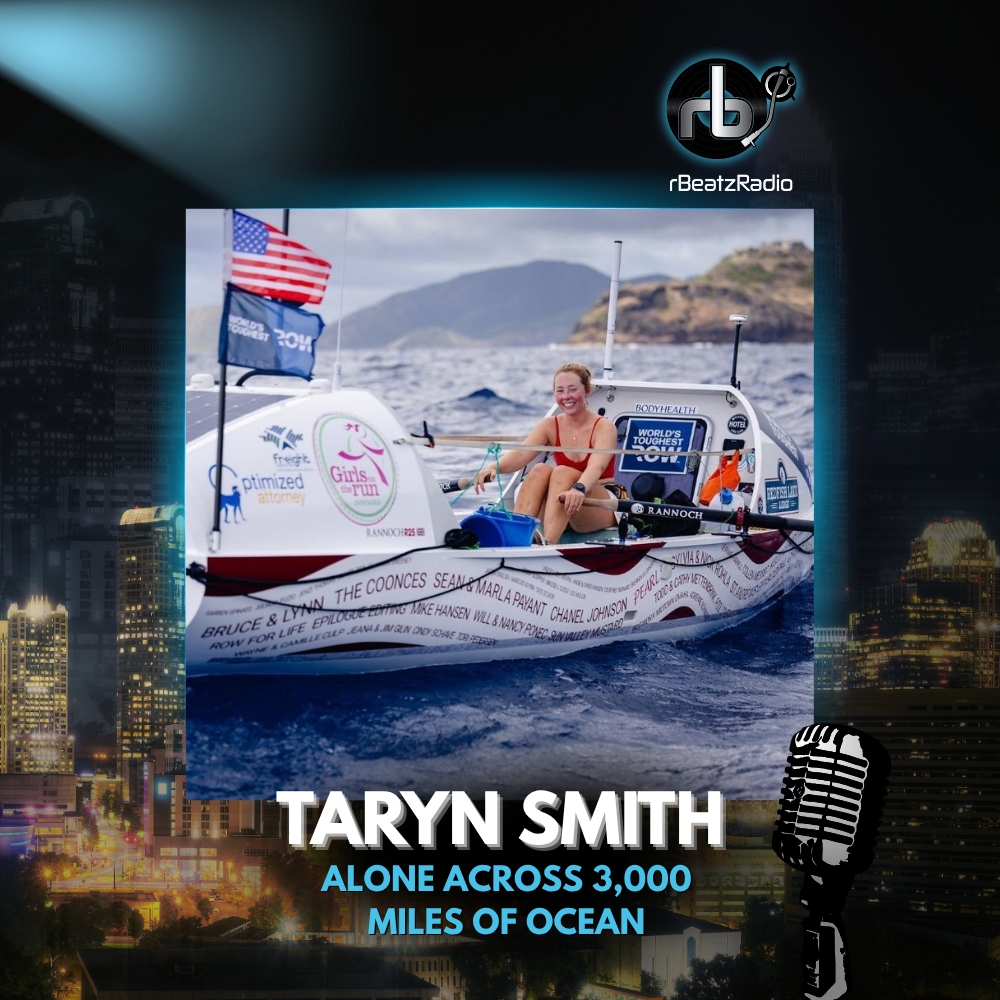
What it took to row 3,000 miles across the Atlantic alone
Taryn Smith joins Jennifer Busco for a conversation about what it really takes to do something extraordinary. After rowing 3,000 miles across the Atlantic Ocean alone, Taryn reflects on resilience, impermanence, joy, and the role community plays in helping us do big things. This episode of Oui Talk Raw is honest, inspiring, and rooted in the mindset behind endurance.
How joy, impermanence, and community shaped the journey
Taryn Smith
Key Takeaways
- Big dreams don’t require you to have everything figured out on day one. Taryn began as a complete beginner and spent years learning what she needed to know.
- Small steps can eventually create extraordinary results. Three years of preparation led to a 3,000-mile, 46-day Atlantic crossing.
- Storms are temporary. One of Taryn’s biggest lessons was learning that even frightening conditions eventually change.
- Solitude can reveal who you are beneath the noise. Forty-six days without social media, news, advertising or mirrors gave Taryn an unusual sense of freedom.
- Resilience doesn’t mean doing everything alone. Taryn’s community provided emotional strength throughout the crossing.
- External validation isn’t the same as purpose. Her time at sea helped her identify what actually mattered to her.
- Community can reach farther than physical proximity. Although Taryn was thousands of miles from land, she felt deeply connected to the people supporting her.
- Joy can exist alongside fear. Some of Taryn’s happiest moments happened during an experience that was also incredibly dangerous.
- Self-compassion matters. The isolation gave Taryn time to recognize unhelpful thought patterns and become kinder toward herself.
- Don’t rush the next adventure. Sometimes the right next step is waiting until inspiration arrives.
- Letting go is a skill. Taryn’s experience reinforced the idea that accepting impermanence can create space for something new.
- Do the thing that keeps calling you. Taryn’s childhood dream of being in the middle of the ocean eventually became reality.
Taryn Smith Rowed 3,000 Miles Across the Atlantic — and Discovered the Freedom of Letting Go
What does it take to spend 46 days alone in the middle of the Atlantic Ocean, more than 3,000 miles from land, facing 30-foot waves, sharks, exhaustion, loneliness and the possibility that things could go very wrong?
For Taryn Smith, it took three years of preparation, a whole lot of courage, a strong community behind her, and a willingness to learn that even the biggest storms eventually pass.
On this episode of Oui Talk Raw, host Jennifer Busco talks with Taryn, an ocean rower, yoga instructor and the first American woman to compete solo in the world’s toughest row. What begins as a conversation about an extraordinary physical challenge quickly becomes something much deeper: a conversation about fear, identity, community, impermanence, joy and what happens when you remove nearly all of the outside noise from your life.
Taryn Smith’s Journey From Nebraska to the Middle of the Atlantic Ocean
Taryn wasn’t a lifelong rower. In fact, she had no rowing or nautical background when she decided she wanted to cross the Atlantic alone.
Her inspiration came from an article in Vogue about four women who rowed from San Francisco to Hawaii. Something about their story immediately clicked with her. She began researching ocean rowing and discovered that people without rowing backgrounds had taken on the challenge.
So she decided she would, too.
Her friends and family understandably thought it was crazy.
But Taryn describes the decision as instinctual. She even remembered that when she was in third grade, she had written that if she could go anywhere in the world, she would choose the middle of the ocean.
That childhood answer eventually became a very real destination.
Three Years of Training for a 46-Day Ocean Crossing
Taryn spent approximately two to three years preparing for the crossing. She worked with an experienced coach, trained on an indoor rowing machine, traveled to England to learn proper rowing technique and eventually lived aboard her 24-foot ocean rowing boat while training.
She learned not only how to row, but how to manage an entire vessel by herself.
That meant cleaning the boat, scraping barnacles, maintaining equipment, keeping the solar panels clean and learning how to make herself feel at home on a tiny boat in the middle of an enormous environment.
Taryn developed a particularly meaningful relationship with the boat itself. She says she felt that the vessel took care of her, which meant she felt responsible for taking care of it in return.
That relationship became especially important once she was thousands of miles from land.
What It’s Really Like to Row Alone Across the Atlantic
Taryn packed 85 days of food because she had no way of knowing exactly how long the crossing would take.
She ultimately needed 46 days.
Her days developed their own rhythm. She would wake before sunrise, row for hours while listening mostly to music, stop for breakfast, continue rowing, record her coordinates and observations in her captain’s log, check equipment, make fresh water with a desalination system, eat dinner around sunset and then continue rowing into the evening.
Even sleep required work.
She might spend seven or eight hours in her cabin, but she would wake every few hours to check her course and make sure the boat was still moving in the right direction.
It was a lifestyle built around constant awareness.
And yet, despite the danger and isolation, Taryn found an unexpected amount of joy.
Sharks, Whales, 30-Foot Waves and a Very Special Bird
Taryn’s first week at sea surprised her.
She had been terrified before leaving, imagining everything that could go wrong. But once she was actually out there, she found herself incredibly happy.
On her very first morning, she saw a shark swimming around her boat.
Then she met what became one of the most memorable characters of her journey: a little bird that repeatedly flew around her boat, diving into the waves and returning to circle her.
Taryn named the bird Jo March after the character from Little Women.
The bird disappeared for a couple of days but returned, eventually becoming a comforting presence throughout the crossing.
Jennifer naturally wondered whether Jo might have been some kind of spiritual sign or guide. Taryn didn’t dismiss the idea. Instead, she described the feeling that someone or something was looking out for her.
And the wildlife wasn’t limited to sharks and birds.
She encountered a massive marlin, estimated at around 700 pounds, during one of the roughest stretches of the journey. She also experienced one of her most beautiful moments when a whale swam just a few feet beneath her boat at sunset.
The Atlantic could be terrifying.
It could also be breathtaking.
The Day Taryn Faced 30-Foot Waves
Day 27 was the first time Taryn remembers being truly scared.
She had already gone nearly two days without proper sleep because painful hives had developed from sun exposure. Then, around 3 a.m., an alarm sounded because the boat was being blown in the wrong direction.
She went outside and began rowing.
Every time she stopped, the wind pushed the boat back off course.
Then it started raining.
By midday, the waves had reached approximately 30 feet. Some waves hit with enough force to knock Taryn out of her shoes and seat, and the boat came dangerously close to capsizing.
And somehow, in the middle of all of that, a marlin was following one of her oars.
It was one of those moments when the adventure stopped being an exciting idea and became a very real survival situation.
Learning That Every Storm Eventually Passes
Taryn’s yoga practice became especially relevant as the weather continued to change.
At first, she felt attached to the conditions. When storms arrived, fear would take over and she would wonder how she could possibly keep doing it.
But the ocean taught her something that she continues to carry with her on land: weather changes.
Storms end.
Fear changes.
Nothing stays exactly as it is.
“No matter how big the storm, no matter how scared I was, eventually it was going to end.”
That became a lesson in impermanence, something Jennifer connected directly to the yogic concept of non-attachment.
For Taryn, it wasn’t simply a philosophical idea. She had experienced it physically and emotionally in the middle of the Atlantic.
46 Days Without Social Media Changed How Taryn Saw Herself
One of the most fascinating parts of Taryn’s experience wasn’t actually about rowing.
For 46 days, she didn’t consume news, social media or advertising.
She had Starlink and could send videos home, but she didn’t spend her time consuming the constant stream of information and opinions that normally surrounds everyday life.
She also didn’t have mirrors on the boat.
Without those external inputs, something shifted.
Taryn realized that her thoughts increasingly felt like her own. She wasn’t constantly thinking about what other people expected from her, how she looked or how other people might perceive her.
Jennifer immediately recognized the freedom in that experience.
For Taryn, the result was surprisingly joyful and playful.
She felt like a kid again.
From External Validation to Collecting Experiences
Returning to land brought another realization: she had become less attached to external validation and material things.
Instead, she wanted to focus on experiences.
That shift is one of the biggest takeaways from her crossing. The Atlantic didn’t just challenge Taryn physically. It forced her to examine the invisible pressures that influence how people live their lives every day.
Without followers, likes, advertisements, mirrors and constant social input, she had the space to ask a much more fundamental question:
How Can You Be Alone and Still Feel Surrounded by People?
One of the most powerful themes of Jennifer and Taryn’s conversation is the apparent contradiction at the center of Taryn’s journey.
She rowed across an ocean alone.
But she wasn’t truly alone.
Friends, family, supporters and strangers followed her journey from land. She called home every day when she could. People sent voice messages. People prayed for her. People sponsored miles of her journey.
Her grassroots campaign to fund the boat included friends and family, a farmer in western Nebraska honoring his late wife and her father’s high school class.
She felt the support.
She felt the love.
And she says that community gave her resilience.
“I felt cocooned in love while I was out there, which sounds a little corny, but I’ve really never felt less alone in my entire life.”
That idea may be one of the most surprising lessons of the entire story: physical solitude doesn’t necessarily mean emotional isolation.
Taryn Smith, Girls on the Run and the Power of Purpose
Taryn also connected her ocean crossing to Girls on the Run, a nonprofit focused on empowering girls through running and physical activity.
She wanted her adventure to represent something beyond herself.
Through the journey, she helped raise $40,000 for the Girls on the Run Nebraska chapter.
For Taryn, the connection made sense. She believes the world is better when girls participate in sports, and she saw parallels between the organization’s mission and what she hoped to accomplish through her own challenge.
Perhaps one of the most meaningful parts of that experience was hearing that parents were showing her videos to their children.
Knowing that young girls and boys were watching her journey made the experience even more meaningful.
The Hardest Part Wasn’t Always the Storms
Jennifer asks Taryn about loneliness, and the answer reveals another layer of the crossing.
Taryn says loneliness became especially difficult during the second half of the journey.
Her strategy was simple but powerful: remind herself that the situation was temporary and stay connected to the people she loved.
Voice messages became a daily ritual.
She would look forward to listening to messages from friends at the end of the day. Because she only used her phone once a day, those conversations didn’t become another source of constant stimulation.
Instead, they became something she genuinely treasured.
What Taryn Learned From Listening to Her Own Internal Dialogue
With so little outside noise, Taryn had an unusual opportunity to observe her own thoughts.
She discovered patterns she didn’t particularly like.
And rather than judging herself for them, she learned to become kinder and more patient with herself.
That may be one of the most lasting lessons of her ocean crossing.
The challenge wasn’t only about becoming tougher.
It was about becoming more compassionate toward herself.
The Highest Highs and Lowest Lows of the Atlantic Crossing
When Jennifer asks Taryn to identify the highest and lowest moments of the journey, two very different memories emerge.
One of her highest highs came at sunset, when a whale passed just beneath her boat. It was close enough for Taryn to hear it breathe.
One of the lowest moments came after an especially difficult day of weather. Taryn called her father expecting reassurance that the conditions would improve.
Instead, he told her that the same conditions might continue for another week.
She broke down.
But that moment eventually reinforced the same lesson she had been learning throughout the journey: conditions change.
The storm doesn’t last forever.
The Last Mile Wasn’t Quite as Easy as Taryn Expected
After 3,000 miles, you might think the final mile would be easy.
Not necessarily.
As Taryn approached Antigua, she became worried that she was too close to the cliffs. The wind was pushing her toward land, and in a moment of panic, she began rowing in the wrong direction.
The team monitoring her from land called repeatedly.
Eventually, a media boat came out to help guide her safely into Nelson’s Dockyard.
The experience became one final lesson about fear and perception.
Taryn realized that what she thought was happening wasn’t actually what was happening. Her depth perception had been distorted after spending so much time at sea.
After 2,999 miles, the final obstacle was partly a matter of perspective.
She eventually crossed between the buoys to cheers, flares and a crowd waiting in the harbor.
And her first post-crossing drink?
A gin and tonic.
Her first real food included fresh fruit and, later, barbecue with friends.
What Comes Next for Taryn Smith?
Taryn’s story isn’t ending with the Atlantic crossing.
A documentary about the row has been produced by Nebraska’s Good Life Network. She’s also writing a book and speaking publicly about resilience, courage and bringing ambitious goals to life.
But she isn’t rushing into another extreme outdoor adventure.
And that’s intentional.
Taryn says she hasn’t yet experienced that unmistakable inspiration that has driven her previous adventures. She’s waiting for it.
In the meantime, she’s moving from Nebraska to New York.
Her boat, meanwhile, is being sold and will go on to another ocean rower.
It’s a fitting transition for a vessel that carried Taryn through such an extraordinary chapter.
Taryn’s Advice: Start With the Dream, Then Take Small Bites
For anyone watching Taryn’s story and thinking, I want to do something bold too, her advice isn’t to immediately quit everything and row across an ocean.
It’s to start.
Dream big, but then figure out what you can realistically do today.
Taryn spent three years preparing for a 46-day crossing. She didn’t wake up one morning and magically become capable of rowing 3,000 miles.
She took small steps.
She trained.
She learned.
She prepared.
She adapted.
And eventually, those small steps became an extraordinary accomplishment.
“Thanks to Impermanence, Anything Is Possible”
Taryn’s final piece of wisdom comes from Thich Nhat Hanh:
“thanks to impermanence, anything is possible.”
For someone who spent 46 days watching the ocean change, confronting fear and learning that every storm eventually passes, the quote feels particularly fitting.
Her story isn’t really about conquering the ocean.
It’s about learning to move with change instead of fighting it.
Jennifer and Taryn’s conversation ultimately circles back to one of the simplest and hardest lessons in life: letting go.
Letting go of fear.
Letting go of external validation.
Letting go of old thought patterns.
Letting go of the idea that everything has to remain permanent.
And, sometimes, letting go is exactly where the joy begins.
More Artists and Show Episodes