
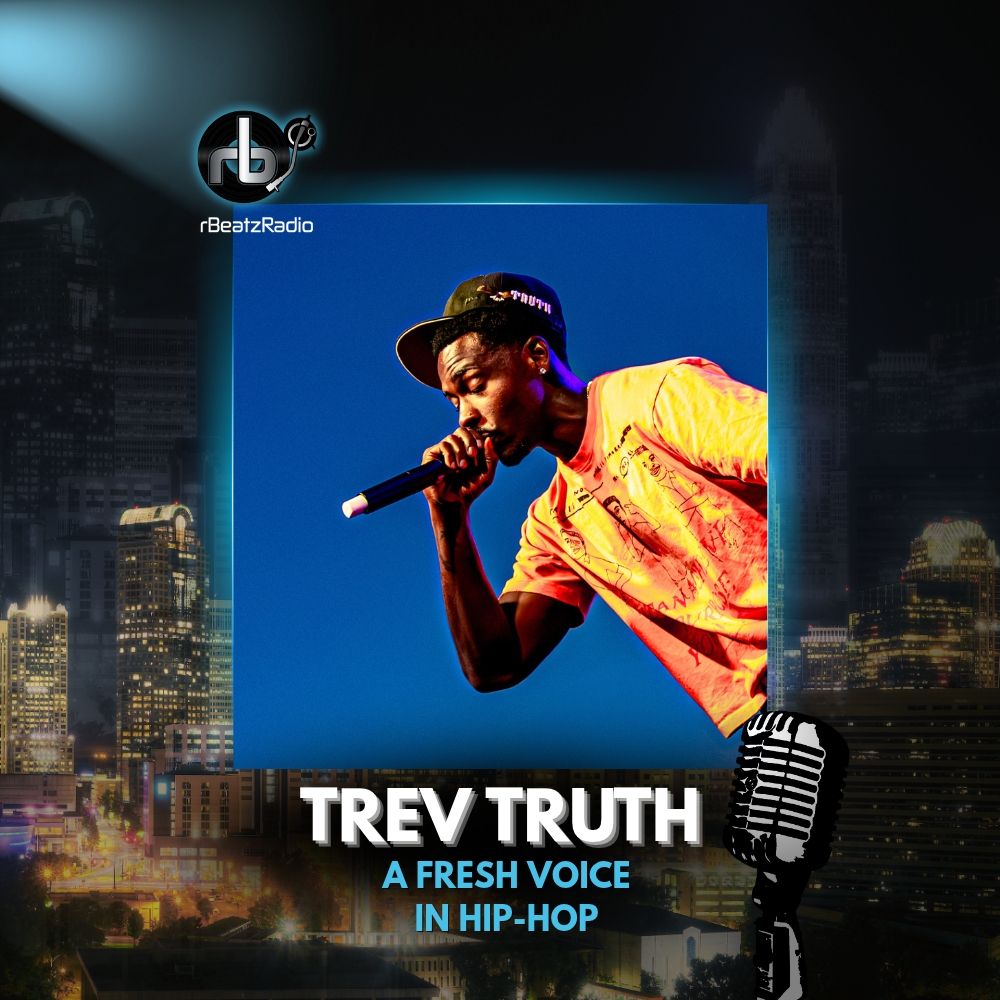
What Trev Truth Is Bringing to the Still Here EP
Trev Truth joins Terry Hudson on Local Music Somewhere for a conversation about his music and the work behind his growing audience. Known for records like “Moonlight,” “Over Wit,” and “So Fly,” Trev brings together smooth melodies, sharp delivery, and hard-knocking drums. The episode spotlights his Still Here EP, recent appearances at 910 Future Fest featuring Waka Flocka and Lloyd, and Confluence in Charlotte, with a look at the ambition, relationships, and personal growth reflected in his artistry.
The Sound and Stories Behind Trev Truth’s Music
Trev Truth
Key Takeaways
- Your path can change: Trev originally saw himself pursuing athletics, but music became his direction after circumstances pushed him to reconsider his future.
- Finding your sound takes time: Working with Ray Mays and experimenting with different flows helped Trev develop his melodic hip-hop identity.
- Don’t force the creative process: Some of Trev’s strongest ideas have come during late-night recording sessions when he allowed the music to develop naturally.
- Your first attempt doesn’t have to be perfect: Terry emphasizes that learning a new skill takes time, and the first attempt is often the beginning of something much better.
- Understand what motivates you: The EP Still Here represents Trev’s realization that his love for music needs to exist beyond the excitement of performing.
- Live performances create opportunities: His experience at 910 Future Fest demonstrates how preparation, confidence, and the right performance environment can open doors.
- Behind-the-scenes content builds connections: Showing the personalities and experiences behind the music gives audiences another reason to become invested in an artist.
- Represent where you come from: Trev embraces Fayetteville’s musical influence while continuing to develop a sound that separates him from other artists.
- Know what kind of career you want: Trev understands that he wants the structure, resources, and opportunities that a record label could provide.
- Talent needs direction: Tez makes the point that having good music isn’t enough. Artists also need a plan, promotion, honest feedback, and a team.
- Interesting can be better than perfect: Creativity isn’t always about following traditional formulas. Emotion, delivery, and individuality can be just as important.
- Use the tools available: Social media, streaming, and direct-to-fan platforms give emerging artists more ways to reach audiences and develop their businesses.
- Put your goals in writing: Terry’s advice to reverse-engineer big ambitions gives artists a practical way to turn dreams into achievable steps.
- Keep collaborating: Trev’s upcoming projects and connections throughout North Carolina demonstrate the value of building relationships within the creative community.
Trev Truth: Staying True to the Music, Building a Career, and Proving He’s Still Here | Oui Talk Raw
Some artists make music to entertain. Others make music because they have something to say. And then there are artists whose music represents the determination to keep going, keep growing, and keep showing up, regardless of what life throws their way.
On this episode of Oui Talk Raw, Terry Hudson sits down with Fayetteville, North Carolina recording artist Trev Truth for an honest conversation about his musical journey, creative evolution, the independent music scene, and what it takes to build a career in today’s industry.
Joining Trev in the studio are Yelly, who brings her experience in modeling and her growing interest in A&R, and his brother Tez, who adds his own perspective to the conversation.
From a childhood spent playing sports to discovering his voice in the studio, Trev’s journey hasn’t followed a straight line. He’s developed a melodic hip-hop sound that combines smooth vocals, catchy flows, and a willingness to experiment. But beyond the music, there’s a bigger story about learning his craft, finding his identity, building a team, and understanding what it means to still be here.
Terry brings his familiar industry perspective, asking questions that go beyond the music itself and giving Trev room to talk about both the creative and business sides of his journey.
Trev Truth’s Musical Journey: From Football Fields to the Recording Studio
Trev Truth didn’t initially picture himself pursuing a career in music. Growing up in Fayetteville, North Carolina, he was more interested in athletics. Football, basketball, and track were where he thought his future might lead.
Music was already part of his life, though. His brother was making music during middle and high school, and Trev occasionally sang in church choir alongside him. At first, he wasn’t particularly interested in following that path. In fact, he thought his brother’s musical ambitions were a little corny.
That changed over time.
Around the age of 11 or 12, Trev started contributing ad-libs to one of his brother’s songs. Even then, music wasn’t immediately his priority. He continued playing sports and eventually played football in college as a safety.
After experiencing two concussions, however, he began reconsidering his future in athletics. Music, which had once been something he casually participated in, started looking like a real opportunity.
A college friend brought him into the studio, and once again, Trev was asked to contribute some ad-libs. This time, something clicked.
He fell in love with the process and began making music throughout college.
Learning to Find His Own Sound
Like many developing artists, Trev’s earliest music didn’t necessarily sound like the artist he would eventually become.
Initially, his songs focused heavily on relationships and breakups. He would simply say what he wanted to say without thinking too much about the delivery, flow, or how the lyrics would connect with listeners.
That began changing when he connected with his friend Ray Mays.
Ray helped put him through what Trev described as a musical boot camp, introducing him to different flows, approaches to songwriting, and ways to communicate familiar ideas in more interesting ways.
His influences also helped shape his sound. Trev points to Drake as a major influence, along with artists such as Ne-Yo, Justin Bieber, and newer underground hip-hop artists.
Rather than trying to become an overly technical lyricist, Trev began recognizing where his strengths were.
He grew up singing, so he already had a foundation in melody and vocal delivery. He decided to combine that ability with hip-hop, creating a sound that gives listeners something to feel rather than simply something to hear.
That balance has become an important part of his identity as a melodic rapper.
The Creative Process Behind Trev Truth’s Music
One thing that stands out about Trev’s music is the variety. His songs don’t all follow the same formula, and he enjoys experimenting with different instrumentals, melodies, and flows.
During the conversation, Terry points out that many developing artists can fall into the habit of making songs that sound too similar. Trev, however, has been exploring different musical directions and building a catalog with a wider range of moods.
Why “So Fly” Became a Turning Point
When Terry asks which song represents Trev the most, he identifies “So Fly.”
The song came after a period when he had been making music that felt too sad or monotone. He eventually reached a point where he stopped recording for approximately two months because he wanted to figure out how to bring more personality and energy into his music.
Then, around 3 a.m. after getting home from work, inspiration finally hit.
He started playing around with lyrics on his phone, found the beat, and began developing the song naturally.
For Trev, “So Fly” represented the moment when he felt he had finally figured out how to create music that could connect with people in a different way.
He wanted to make songs that could lift someone’s mood, get people moving in their cars, and still have enough range to explore other emotions.
It became a turning point in his confidence as an artist.
“Over With”: Turning Relationship Emotions Into Music
Another track Terry wanted to explore was “Over With,” which Trev created alongside his friend Dame.
The idea started with a simple conversation about making a high-energy party song. After spending time searching for the right beat, the two began experimenting with melodies and lyrics.
The song eventually developed into something that captures the complicated emotions of a relationship coming to an end.
Trev uses melodic vocals to communicate the feeling of not quite being ready to let go, while the beat switch gives him an opportunity to change his flow and energy.
Rather than forcing every part of the song into a rigid structure, he prefers allowing the music to develop naturally.
Terry connects with that emotional direction, describing the kind of scene the song brings to mind: someone driving home after a breakup, watching the city lights pass by, and replaying the song because it captures exactly how they’re feeling.
It’s a good example of how music can connect with listeners through shared experiences.
“Friend or Foe”: Understanding the Business Behind the Music
Trev also discusses “Friend or Foe,” a track from his latest EP that holds a special place in his catalog.
The song reflects a period when he was actively reaching out, networking, and trying to get his music heard.
He wanted the instrumental to have a cinematic feel while creating a catchy hook that listeners could remember.
Even the opening idea about getting the music on the radio connects to the reality of being an emerging artist: making the music is one thing, but getting it in front of the right people is another.
The music video also brought its own creative opportunities. Trev and his team found an abandoned bus and another location in Fayetteville to help bring the visual concept to life.
His willingness to explore unusual locations and make something visually interesting is another part of his creative approach.
“Out of Here”: Creating Music for the Stage
While “Over With” explores relationship emotions, “Out of Here” was created with a different purpose.
Trev wanted a song that would get people moving during his live performances.
After receiving feedback from friends and his father that he needed more music that encouraged audiences to jump, dance, and participate, he went back to the drawing board.
It took him another month to figure out the direction.
Eventually, another late-night creative session and a beat that sounded different from anything he’d previously worked with helped bring the song together.
The result was a high-energy track built around the idea of living life, enjoying the moment, and working toward something bigger.
Terry uses this as an opportunity to discuss an important lesson for developing artists: learning something new can be frustrating at first, but once you’ve worked through that initial challenge, it becomes part of your creative foundation.
His point is simple: your first attempt won’t necessarily be your masterpiece, but without that first attempt, you’ll never get there.
Still Here: The Meaning Behind Trev Truth’s Latest EP
FEATURED PROJECT
Trev’s latest EP, Still Here, carries a title that means much more than simply continuing to release music.
He explains that after performing several major shows in Fayetteville, he experienced what he calls a “performers high.”
After an exciting performance, he would feel energized and immediately start thinking about what came next. But when the excitement wore off, he sometimes experienced the opposite feeling.
Without another show immediately on the calendar, he would question what he was working toward.
That led him to recognize something important: he needed to find consistency in his love for making music, not just in the excitement of performing it.
The title Still Here represents that realization.
Whether he’s performing, recording, networking, or simply working behind the scenes, he’s still Trev Truth. He’s still making music, still pushing forward, and still committed to his craft.
What Does It Mean to Still Be Here?
Terry connects the EP’s title to something larger about the creative journey.
The music industry is full of rejection. Artists face challenges getting booked, getting noticed, finding the right collaborators, and convincing people to believe in what they’re creating.
There are also personal challenges, creative frustrations, and moments when the work doesn’t come together the way an artist envisioned.
Terry describes the importance of recognizing those moments when everything has been tested, but you’re still standing.
For Trev, Still Here is a statement of persistence.
It isn’t about pretending everything is easy. It’s about continuing to show up even when the excitement fades and the next opportunity hasn’t arrived yet.
That message can resonate with musicians, entrepreneurs, creatives, and anyone trying to build something meaningful.
Performing Live: From Fayetteville Stages to Bigger Opportunities
Trev has been building his presence throughout North Carolina, taking opportunities to perform at festivals and showcases that help him connect with new audiences.
Among the experiences discussed are the Confluence Music Festival, Dogwood Festival, and Fayetteville’s 910 Future Fest.
Terry first encountered Trev performing during the Confluence Music Festival showcase at Petra’s in Charlotte. The venue was packed, the crowd was supportive, and Trev made a strong impression.
That performance was enough to convince Terry that he needed to bring him onto the show.
Why 910 Future Fest Was His Favorite Performance
Interestingly, Trev identifies 910 Future Fest as his favorite performance experience.
Although the set itself was relatively short, the production made a lasting impression.
He particularly enjoyed having a large screen behind him, which made the experience feel bigger and more like performing on a major tour.
He admits that he was extremely nervous backstage before going on.
But once he stepped out, that nervous energy seemed to turn into something positive.
He jumped around, brought energy to the performance, and felt that his vocals sounded especially good with the mix.
He also gives a shoutout to DJ Rico for delivering a great mix.
The performance was part of a show where Trev opened for Waka Flocka and Lloyd. His performance caught Waka Flocka’s attention, and Trev was invited into his dressing room to talk afterward.
For an emerging artist, those moments can be meaningful. They’re opportunities to make connections, build confidence, and see how far the work can take you.
Behind the Scenes: Why Trev Truth Shares More Than Just Music
Trev isn’t only interested in sharing finished songs and polished performances.
He also enjoys documenting the process through his YouTube Day in the Life videos and other behind-the-scenes content.
One of the things he enjoys most is showing the personality of his friend group.
He jokes that although people might see them as a serious or intimidating entourage, they’re really just friends who spend their time joking around and doing ridiculous things.
He wants people to see that side of the journey.
The content also gives audiences a look at the modeling shoots, creative collaborations, trips, music videos, and everyday experiences that happen outside the recording studio.
Why Authentic Behind-the-Scenes Content Matters
Terry agrees that audiences enjoy seeing what happens behind the scenes.
He explains that aspiring artists often want to know more than what a finished song sounds like. They want to understand how the process works.
- What happens when an artist enters the studio?
- How do artists prepare for live performances?
- Where do they find locations for music videos?
- How do they organize creative collaborations?
- What does a typical day look like for someone building a music career?
That kind of content makes the artist more relatable and gives fans another reason to connect.
Trev’s interest in fashion and lifestyle content also influences how he approaches his videos. He’s watched clothing brand owners document their daily routines and wanted to bring that same approach into his own creative world.
It’s another way he’s developing his brand beyond the music.
Fayetteville’s Hip-Hop Scene: Community, Influence, and Individuality
Every music city has its own identity, and Terry makes a point of exploring what makes each scene different.
For Trev, Fayetteville’s musical identity is strongly influenced by J. Cole.
The city’s connection to J. Cole has helped inspire a generation of artists who focus on lyrical storytelling, conscious hip-hop, and introspective music.
Trev recognizes that influence but also understands that his own sound is different.
He doesn’t necessarily consider himself a traditional lyrical or conscious rapper. Instead, his melodic approach gives him an opportunity to stand out while still being part of the Fayetteville music community.
The Importance of Fayetteville’s Community
Beyond the music, Trev describes Fayetteville as a city where people are willing to connect, collaborate, and help one another.
He points to the community’s willingness to support local talent and create opportunities for people to branch out.
He also mentions The Two Six Project, a Fayetteville nonprofit that has been involved in connecting people and creating opportunities beyond the city.
Fayetteville’s military presence, including Fort Bragg, is another part of the city’s identity and community culture.
When it comes to recognizable local landmarks, Trev mentions the Market House in downtown Fayetteville and Segra Stadium, where 910 Future Fest took place.
For him, representing the Ville is about more than putting a city name in a song. It’s about being part of a community that wants to see its people succeed.
Independent Artist vs. Record Label: Why Trev Wants a Major Opportunity
One of the more interesting parts of the conversation comes when Terry asks Trev whether he wants to remain independent or eventually sign with a record label.
Trev doesn’t hesitate.
He wants to sign with a label.
His reasoning is interesting because it isn’t simply about fame or having someone else handle the business.
He genuinely likes structure.
Growing up with a routine of school, sports, and scheduled activities helped him develop an appreciation for having direction and knowing what comes next.
He believes a record label could provide:
- A larger platform for his music.
- Stronger promotional opportunities.
- Industry connections and resources.
- Professional guidance.
- Business education and experience.
- Access to opportunities he might not reach independently.
Trev also recognizes that independence has its advantages. He isn’t dismissing independent artists or suggesting that a label is the only way to succeed.
He simply knows the type of support and structure he wants as he continues developing his career.
Knowing When You’re Ready
Trev reflects on how his perspective has changed since he first started making music.
In 2022, he thought he was ready for a record deal. Looking back, he recognizes that he still had plenty to learn.
He feels differently now.
After years of developing his sound, performing, collaborating, and building his presence, he believes he’s reached a point where he could make the most of a record-label opportunity.
Terry agrees that understanding your readiness is important.
Having worked in artist management and as a record-label managing partner, he explains that labels can offer valuable resources, including radio promotion, publicity, publishing support, and industry relationships.
He also acknowledges that independence is a legitimate route, but it isn’t necessarily the right choice for every artist.
The important thing is understanding what kind of career you want to build.
The Reality of Today’s Music Industry: Talent, Marketing, and Having a Plan
The conversation takes another interesting turn when Terry asks whether independent artists have more opportunities today than artists had in previous generations.
Trev believes the answer is somewhere in the middle.
Today’s artists have access to streaming services, social media, digital distribution, and tools that make it easier to reach listeners without traditional industry gatekeepers.
But the market is also extremely crowded.
Especially in hip-hop, artists are constantly releasing music and competing for attention.
Trev points out that someone can have a viral TikTok song without ever developing a live performance career. On the other hand, an artist can perform regularly and still struggle to get people familiar with their music.
Having one part of the equation doesn’t automatically guarantee success in another.
Why Talent Alone Isn’t Always Enough
Tez adds an important perspective to this discussion.
He believes many artists struggle because they don’t have direction.
An artist can record dozens of songs, have incredible talent, and still fail to build momentum if there’s no promotional strategy or consistent plan behind the music.
He also speaks candidly about constructive criticism.
Rather than simply telling someone their music is great to make them feel good, he believes artists need honest feedback about their delivery, cadence, flow, and overall approach.
His perspective is that criticism should give someone an opportunity to improve rather than simply discourage them.
Why Being Interesting Can Matter More Than Being Perfect
Trev and Tez also discuss how the expectations around hip-hop have changed.
For Trev, music isn’t always about having the most complicated lyrics or making every line rhyme perfectly.
He pays attention to emotion, cadence, how an artist rides a beat, and whether the delivery keeps his attention.
He compares music to fashion. Not everything needs to match perfectly for the overall look to work.
Sometimes the unexpected combination is what makes something interesting.
It’s a refreshing perspective on creativity: technical ability matters, but so does personality, originality, and the ability to hold someone’s attention.
Social Media and Music Discovery: Building an Audience in the Digital Age
Social media has become an essential part of the modern music business, and both Terry and Trev recognize how much the landscape has changed.
Trev appreciates how platforms such as TikTok and Instagram allow listeners to discover artists they might never have encountered through traditional radio.
He compares finding new music to discovering a new restaurant. Sometimes you’re simply scrolling, something catches your attention, and suddenly you’ve found a new favorite.
But he also acknowledges the pressure that comes with constantly needing to post.
Some artists prefer to remain mysterious and release music occasionally. Today’s digital environment, however, rewards consistency and regular engagement.
Why Artists Need to Think Beyond Streaming
Terry expands on this by explaining how social media algorithms can introduce artists to completely new audiences based on their interests.
An artist doesn’t necessarily need an established fanbase to get noticed. A single piece of engaging content can reach people who have never heard their name.
He encourages emerging artists to take advantage of the tools available to them, even if all they have is a cell phone.
Terry also introduces Trev and Yelly to the idea of superfan platforms, mentioning EVEN as an example.
These platforms offer opportunities to connect music, merchandise, and fan engagement in ways that can create additional revenue beyond traditional streaming.
For artists building their careers, the lesson is that music discovery, audience development, and business strategy all need to work together.
Yelly’s Journey Into Modeling and A&R
Although Trev is the featured guest, Yelly brings another interesting perspective to the conversation.
A model with connections throughout Durham, Raleigh, Charlotte, Atlanta, and California, she explains how her creative network helped bring her into Trev’s world.
Their connection started through a mutual friend and a group chat for content creators in Fayetteville.
From there, she began participating in photo shoots, creative projects, and music video content.
Trev noticed her growing social media presence and the connections she had built, recognizing an opportunity to work together.
That relationship eventually developed into a role where she could contribute to his creative and professional development.
Building Toward a Future in Artist & Repertoire
Yelly explains that her interest in A&R developed naturally through her creative connections and experiences.
She isn’t claiming to be deeply established in the role yet. She has also recently relocated from Durham and is working on getting other aspects of her life organized.
Her goal is to become more involved in A&R in 2027.
Terry encourages her to begin learning the business side of the music industry and recommends two books:
- All You Need to Know About the Music Business by Donald S. Passman.
- How to Make It in the New Music Business by Ari Herstand.
Both offer useful starting points for understanding the business behind the creative work.
What’s Next for Trev Truth? Sync Licensing, Touring, and New Collaborations
When Terry asks about his immediate career goals, Trev identifies two major ambitions.
First, he wants to get one of his songs placed in a movie through music synchronization.
Second, he wants to tour with another artist.
These are goals that reflect his interest in expanding beyond local performances and finding new ways to introduce his music to larger audiences.
Dream Collaborations and Touring Opportunities
When asked who his dream touring partners would be, Trev has several artists in mind.
His ultimate dream is to tour with Drake.
He also mentions:
- Huncho.
- Polo G.
- Bryson Tiller.
- Meek Mill.
- Fridayy.
- Rod Wave.
Terry encourages him to write those names down and reverse-engineer the process.
Rather than simply imagining the opportunity, he wants Trev to identify what it would take to get there, including the people he needs to meet, the skills he needs to develop, and the business relationships that could help make those opportunities possible.
Terry shares his own philosophy of putting goals into writing and planning backward from the desired outcome.
It’s a practical reminder that ambition becomes more useful when it’s connected to a plan.
New Music and Collaborations on the Way
Trev also shares that he’s preparing to get back into the studio, with plans to collaborate with several North Carolina creatives.
Among the names mentioned are CJ Monet, William Price, and DJ Rico, along with additional Fayetteville connections.
He wants to collaborate more and continue expanding his musical network.
There is also discussion about bringing Trev and his team back to rBeatz for a potential live performance session.
For listeners who enjoyed the conversation, there may be more opportunities to see Trev’s music and personality come together in a live setting.
Final Thoughts: Still Here, Still Creating, and Still Building
What makes this conversation with Trev Truth interesting is that it isn’t just about an emerging artist releasing music and looking for his next opportunity.
It’s about the process of figuring out who you are as an artist, recognizing what you’re good at, learning what you still need to improve, and finding the motivation to keep going.
Trev has already experienced several important milestones. He’s developed a sound that reflects his personality, built a growing catalog, performed at festivals and showcases, connected with other creatives, and started thinking more strategically about the business side of his career.
But he’s also honest about the work still ahead.
He wants a record deal. He wants sync placements. He wants to tour. He wants to collaborate with more artists and continue representing Fayetteville.
And he understands that getting there requires more than making good music.
Terry Hudson’s conversation brings out an important distinction between having a dream and building a career around that dream. His questions encourage Trev to think about the relationships, education, planning, and business decisions that can help move him forward.
Yelly and Tez also add another layer to the discussion, showing how an artist’s development often involves a larger creative circle of people contributing their skills, perspectives, and support.
Ultimately, Still Here is more than the title of an EP. It’s a statement about persistence.
Because in an industry where attention can come and go, opportunities don’t always arrive when expected, and rejection is part of the process, continuing to show up matters.
Trev Truth is still here, still making music, and still building toward what’s next.
And as Terry reminds listeners at the end of the show, there’s always music somewhere.
More Artists and Show Episodes


