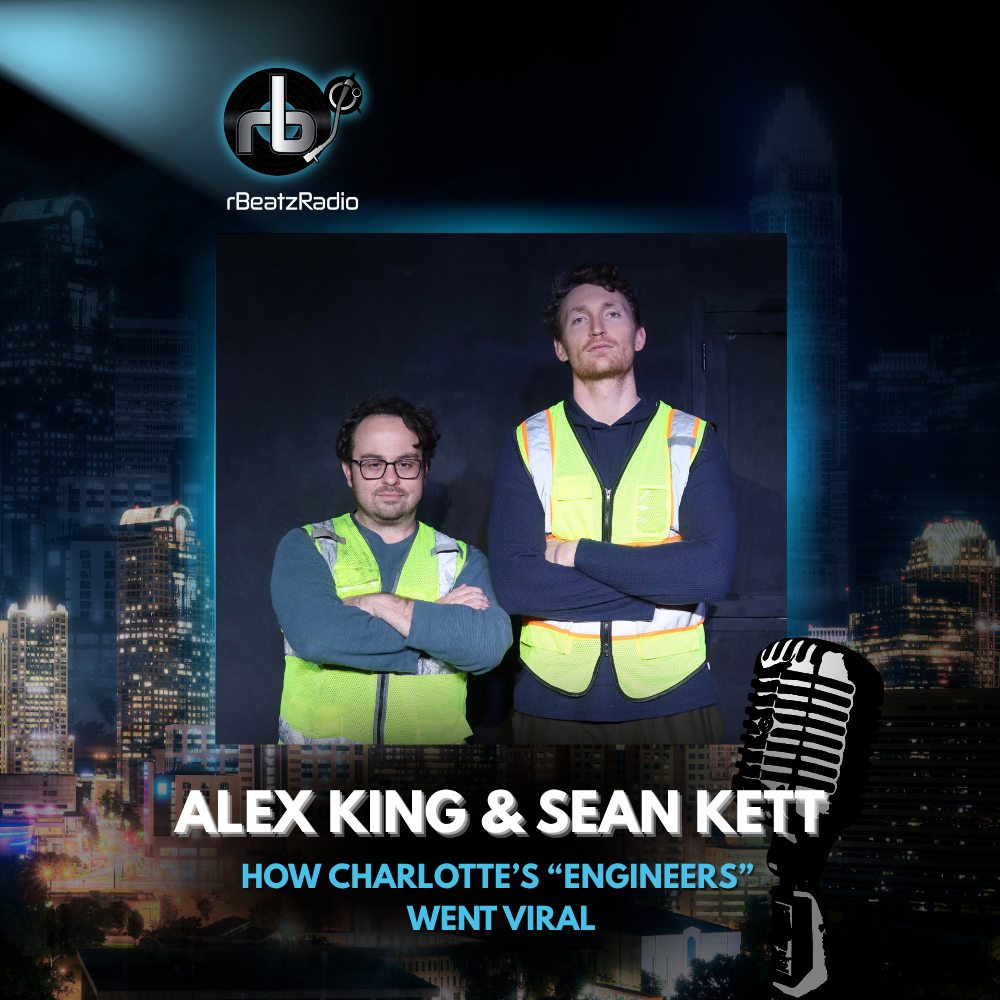
How the Charlotte Engineers Comedy Bit Started
What happens when Charlotte’s everyday frustrations get explained by two sarcastic “engineers”? Comedians Alex King and Sean Kett have turned the quirks of life in the Queen City into a comedy bit that local audiences recognize all too well — from confusing highway exits to grocery store parking lots that seem designed to test everyone’s patience.
On rBeatz Radio, Alex and Sean talk about how their Charlotte engineer sketches came together, why the bit resonates with locals, and what it takes to turn social media comedy into a live experience at Sip City in Plaza Midwood. We get into their creative process, their chemistry as a comedy duo, and the possibility of putting a real Charlotte annoyance on the design table for an improvised comedy segment.
Featured by Axios, Alex and Sean are bringing a distinctly Charlotte perspective to their comedy. Tune in for a conversation about local culture, creative collaboration, and finding humor in the things that drive us all a little crazy.
From Social Media Sketches to Live Comedy at Sip City
Alex King and Sean Kett
Alex King
Alex King is a Charlotte-based comedian and content creator who finds humor in the everyday quirks of city life. Originally from Harrisonburg, Virginia, Alex has built a following through relatable comedy that turns familiar frustrations into entertaining observations.
As one half of the “Charlotte engineers” comedy duo with Sean Kett, Alex helps bring a sarcastic spin to everything from confusing highway exits to questionable parking lot designs. The concept gives Charlotte residents a reason to laugh at the little things they recognize, while showcasing Alex’s knack for turning local experiences into comedy.
Through online sketches and live comedy, Alex continues to connect with audiences who appreciate humor with a distinctly Queen City perspective. Follow along for more comedy, creative collaborations, and entertaining takes on life in Charlotte.
Sean Kett
Sean Kett is a Charlotte-based comedian and content creator known for his relatable takes on everyday life and his work alongside fellow comedian Alex King. Originally from Miami, Florida, Sean brings his comedic perspective to a growing local audience through stand-up, online sketches, and live comedy shows.
As part of the “Charlotte engineers” duo, Sean helps transform the city’s familiar frustrations into sarcastic comedy, imagining the reasoning behind everything from confusing roads to inconvenient parking lots. The sketches celebrate the shared experiences of Charlotte residents while playfully questioning some of the city’s most puzzling design choices.
Alongside Alex, Sean is helping bring the concept beyond social media and into live performances, connecting with audiences through local humor and a collaborative approach to comedy. His work reflects the growing energy of Charlotte’s comedy scene and the fun of finding humor in everyday situations.
Key Takeaways
- Start before you have everything figured out. Creative ideas develop through experimentation, not just planning.
- Authenticity helps audiences connect. Alex and Sean build their comedy around their natural personalities and shared observations.
- Collaboration requires honest feedback. Having a creative partner who can challenge an idea helps strengthen the work.
- Inspiration doesn’t have to mean imitation. Learn from other performers’ techniques while developing your own voice.
- Failure is part of the process. Bombing on stage can be uncomfortable, but it doesn’t have to define your ability or confidence.
- Discipline can take different forms. Sean’s structured writing routine and Alex’s more flexible idea-gathering process show that there isn’t one universal creative formula.
- Everyday frustrations can become creative opportunities. A confusing parking lot or an odd neighborhood design can inspire comedy when viewed from a new perspective.
- Creative growth requires flexibility. Old material can evolve, new formats can emerge, and ideas can find an audience in unexpected ways.
- Friendship makes the process more enjoyable. Finding people who understand your goals and enjoy working with you can make a demanding creative pursuit less isolating.
- You don’t need to start big to build something meaningful. The Charlotte Engineers began with a single video concept and have continued developing it through audience feedback and live performances.
Alex King & Sean Kett: The Charlotte Engineers Bringing Comedy to Everyday Life | Oui Talk Raw
What happens when two comedians decide that Charlotte’s parking lots, neighborhoods, and public transportation systems need a little explaining? You get Alex King and Sean Kett, better known as the Charlotte Engineers, a comedy duo turning everyday frustrations into hilarious conversations about life in the Queen City.
On this episode of Oui Talk Raw on rBeatz.com, host Jennifer Busco welcomes Alex and Sean into the rBeatz VIP Studio for a candid, funny, and occasionally wonderfully ridiculous conversation about their friendship, comedy careers, creative process, and the inspiration behind their popular online videos. Engineers by day and comedians by night—or, as they might have you believe, engineers working a very demanding 30-minute schedule—the pair share how a simple idea about the Harris Teeter parking lot in Plaza Midwood grew into a creative project that continues to resonate with audiences.
Jennifer brings her trademark curiosity and playful energy to the conversation, asking the questions that take the discussion beyond social media laughs. Together, they explore authenticity, self-confidence, creative collaboration, the realities of bombing on stage, and what happens when you turn the things that annoy you into something that brings people together.
Who Are the Charlotte Engineers? Meet Alex King and Sean Kett
Alex King and Sean Kett met at a stand-up comedy open mic in Charlotte approximately two to three years before the interview. Their connection grew from a shared appreciation for each other’s work ethic, writing styles, and ways of looking at the world.
As both comedians explain, stand-up can be an isolating craft. You’re often alone on stage, working through ideas and figuring out what connects with an audience. Finding someone who understands the process, offers honest feedback, and is enjoyable to spend time with outside the comedy club can make a real difference.
Their friendship eventually became a creative partnership. What started as conversations and shared ideas developed into a recognizable online comedy concept: two engineers who supposedly helped design Charlotte’s most questionable infrastructure.
The result is a blend of local humor, exaggerated explanations, and the kind of shared frustration that makes people stop scrolling and say, “Wait, I’ve wondered the exact same thing!”
How a Harris Teeter Parking Lot Inspired Their Comedy
The idea behind the Charlotte Engineers began with a familiar local experience: the Harris Teeter parking lot in Plaza Midwood.
Alex came up with the premise of imagining that the people responsible for designing the parking lot had intentionally made it that way. Instead of simply complaining about a frustrating experience, the duo would create fictional explanations for why the design was actually a brilliant engineering decision.
The first video took off, and audience reactions encouraged them to keep going.
Their approach is deceptively simple. Take something people recognize, identify the absurdity in it, and create an outrageous explanation that treats the whole situation as perfectly reasonable. The more seriously the fictional engineers defend their questionable decisions, the funnier the concept becomes.
And the idea has room to grow. Their videos and town hall-style performances have developed into a creative outlet that allows them to combine observational comedy, improv instincts, local references, and their chemistry as friends.
The Comedy Behind Charlotte’s Most Questionable Designs
Jennifer invites Alex and Sean to explain some of their supposed engineering projects, and the conversation quickly becomes a tour of Charlotte through the eyes of two people who should probably never be handed a city planning blueprint.
Trader Joe’s Parking: An Exercise in Anxiety and Community Building
The Trader Joe’s parking lot becomes one of the episode’s funniest examples of their fictional engineering philosophy.
According to their elaborate explanation, the goal was to limit the number of usable parking spaces, make the spaces inconveniently small, and encourage drivers to circle around repeatedly. Rather than seeing this as a design failure, the duo frames it as an opportunity for human connection.
Why simply park your car when you could roll down your window, negotiate with another driver, and build a meaningful relationship while waiting for a space?
Jennifer shares her own experience of visiting Trader Joe’s to pick up a plant before a birthday party. The parking situation became so frustrating that she experienced an anxiety attack and ultimately left without the plant.
Naturally, the engineers have an explanation. They wanted people to experience feelings, and anxiety apparently made the list.
The exchange captures the heart of their comedy: taking a genuine, relatable frustration and stretching it into an absurd story that feels just believable enough to make the audience laugh.
South End, LoSo, and the Art of Getting Lost
The duo’s fictional engineering work continues with South End, where they describe an approach to neighborhood development that resembles an escape room.
The idea? Create so many similar-looking homes and apartments that residents might struggle to tell where they are. Their explanation of the neighborhood’s appeal to younger residents is just as exaggerated, suggesting that anyone over 30 might already be considered ancient.
Then there’s LoSo, which inspires one of Sean’s memorable bits of wordplay:
“If you can make it in Loso, then you are so-so.”
Jennifer plays along, encouraging the pair to explain their ideas while occasionally making their fictional designs even more ridiculous. The conversation also takes a detour into the Rail Trail, where a supposedly accidental engineering decision leads to more jokes about the way Charlotte has developed.
Their humor works because it doesn’t require audiences to be professional engineers—or even know much about engineering. It simply asks them to recognize the familiar places, laugh at the quirks of city life, and enjoy the absurdity of the explanations.
Charlotte’s Light Rail, Malls, and the Problem of Urban Growth
The discussion expands to Charlotte’s light rail, SouthPark Mall, and the city’s ongoing growth.
The engineers suggest that the light rail needs to sound bigger and more impressive, even if the actual train remains relatively small. They also float the idea of adding more stops so that traveling by rail could take longer than walking.
Their fictional redesign of SouthPark Mall is equally inspired. Cars supposedly came before the stores, creating a shopping experience built around questionable parking decisions. But Sean also offers a more sentimental explanation for the mall’s existence: he wants to bring back mall culture and give a new generation a place to go on dates.
Throughout these stories, Alex and Sean poke fun at development, traffic, parking, and the frustrations of navigating a growing city. The humor isn’t a technical critique of Charlotte’s infrastructure. It’s a creative way to give familiar annoyances a personality and turn local experiences into shared entertainment.
Alex King and Sean Kett on Authenticity, Friendship, and Finding Your Comedy Voice
Although the Charlotte Engineers’ fictional world provides plenty of laughs, Jennifer also makes space for a more personal discussion about what it takes to become a comedian.
Both Alex and Sean value authenticity. They want their content to feel like an extension of who they are rather than a manufactured performance built around a gimmick.
When Jennifer asks whether their online characters differ from their real personalities, their answer reflects that philosophy: what audiences see online is closely connected to who they are off camera.
That doesn’t mean they aren’t developing their characters. They continue to explore different points of view and ways to make the concept more entertaining. But the foundation is still their natural chemistry and the way they think about the world.
Why Honest Feedback Matters in Creative Collaboration
One of the strongest themes in the conversation is the value of having someone who will tell you the truth.
Alex and Sean constantly exchange ideas for videos, jokes, premises, and new approaches. Sometimes the answer is that an idea needs work. Sometimes they find a better angle. And sometimes, as their playful banter makes clear, the feedback is considerably less gentle.
Their different personalities help the partnership work. Sean describes himself as disciplined in his writing routine, while Alex takes a more flexible approach to developing ideas and finding opportunities to create content.
Rather than expecting each other to work in exactly the same way, they recognize that creativity doesn’t always follow a single formula.
Their collaboration also demonstrates an important distinction between inspiration and imitation. They admire other comedians and borrow lessons from their techniques, but they want to apply those lessons in their own voices rather than copy another person’s material.
For Alex and Sean, the goal is to learn how a joke is structured, how physical performance adds energy, or how a comedian creates a connection with an audience—and then figure out how to make those tools work for them.
From Rory Scovel to John Mulaney: Learning From Comedians They Admire
The conversation about inspiration includes comedians whose styles offer different lessons.
Sean appreciates Rory Scovel’s ability to take a bit and keep developing it, exploring ideas and finding new directions as he performs. He also talks about seeing John Mulaney live with Alex and appreciating the confidence and comfort that come with years of experience on stage.
Alex enjoys watching performers who do things differently from him. Rather than trying to reproduce another comedian’s style, he looks for inspiration in their techniques and asks how he can become more effective in his own way.
Jennifer connects their experiences to music, reflecting on what separates a talented performer from someone who can create an emotional connection with a large audience.
The discussion highlights a shared truth across creative fields: technical ability matters, but so does the ability to make an audience feel something.
The Reality of Stand-Up Comedy: Bombing, Self-Doubt, and Getting Back Up
Behind the funny videos and confident performances is a more vulnerable side of comedy.
Alex and Sean talk openly about bombing on stage, dealing with self-doubt, and figuring out how to recover when a performance doesn’t go as planned.
Sean describes a difficult 20-minute set at Greensboro Comedy Zone, where the silence from the audience made every moment feel longer. Alex also shares the challenge of having a joke fall flat when he expected it to work.
For comedians, a disappointing set can feel intensely personal. You’re standing alone in front of a room full of people, trying to connect with them through something you’ve written and practiced. When that connection doesn’t happen, it’s easy to replay every moment afterward.
But the conversation also reveals how friendship can help make the experience more manageable. Calling someone you trust, talking through what happened, and recognizing that one difficult performance doesn’t define your abilities can help keep a bad night in perspective.
Confidence Doesn’t Mean Every Performance Goes Well
Sean shares an idea that stuck with him:
“You can’t bomb if you’re comfortable.”
The point isn’t that an unsuccessful performance magically becomes a success. Instead, it’s about learning to remain present even when things aren’t going well.
Confidence can make the difference between treating a difficult set as a personal failure and treating it as another experience to learn from. It also connects to their larger discussion about self-love and the ability to handle criticism without letting it define you.
Alex admits that imposter syndrome still shows up for him, while Sean explains that his confidence has grown through performing and receiving positive audience reactions.
Their conversation is refreshingly honest about the fact that creative growth isn’t always comfortable. Even people who make others laugh for a living have to work through uncertainty, frustration, and moments when they wonder whether they’re good enough.
Turning Self-Deprecating Humor Into a Healthier Relationship With Yourself
Self-deprecating humor is another major topic. Sean uses it as a core part of his comedy, often turning his own experiences and shortcomings into material. Alex approaches the subject with his own perspective, acknowledging that confidence is something he’s still developing.
Jennifer asks whether comedians ever risk taking their self-criticism too far. It’s an important question because being able to laugh at yourself doesn’t necessarily mean you always feel good about yourself.
Sean reflects on how comedy has helped him build confidence. Getting on stage, sharing his own thoughts, and seeing audiences respond positively can reinforce the feeling that he has something worthwhile to offer.
The conversation also touches on how a joke can change as a person grows. Material that once felt funny or relevant might no longer fit who a comedian has become. Sometimes a joke needs to be retired; other times, it can be revisited from a new perspective.
For Alex and Sean, comedy is an ongoing process of writing, performing, reflecting, and adjusting.
The Creative Process: Discipline, Daily Writing, and Finding New Ideas
The episode offers a useful look at how the two comedians approach their craft outside the spotlight.
Sean describes a structured routine that includes writing for 25 minutes in the morning, transcribing his ideas, editing them, and eventually saying the material aloud to test whether it works.
His approach reflects the idea that comedy is a craft that requires practice. A funny thought might be the beginning of a joke, but developing it into something that consistently connects with an audience takes effort.
Alex’s process is less regimented. He tries to capture ideas when something strikes him as odd or amusing throughout the day. With fewer opportunities to perform stand-up while balancing life with a baby at home, he’s also exploring how those ideas can become social media content.
Their approaches aren’t identical, and that’s part of the point. Creative discipline can look different for different people. One person might thrive on a strict writing schedule, while another develops material by staying observant and recording ideas as they happen.
Why Their Comedy Continues Beyond the Stage
The Charlotte Engineers project gives Alex and Sean another way to practice their comedic instincts.
Their videos allow them to explore premises, test audience reactions, and create something together even when they’re not performing stand-up. The town hall format gives the concept room to expand, letting them revisit earlier designs, introduce new ideas, and interact with audiences through questions and conversation.
They have also produced stand-up shows around Charlotte, including events at venues such as Sip City, while continuing to develop their individual comedy styles.
The combination of individual performance and collaborative content gives them different creative outlets without requiring them to become the same kind of comedian.
What’s Next for the Charlotte Engineers?
What began as a fun idea has grown into a project with opportunities beyond social media.
Alex and Sean explain that people continue to send them messages suggesting new places to explore and local frustrations to turn into comedy. They’ve also had opportunities to perform at private events and participate in fundraisers and nonprofit-related events.
Their next steps include expanding the town hall concept, developing fresh designs, and exploring opportunities in other cities.
Although Charlotte remains their home base, they see potential in bringing the concept to places such as Raleigh, Winston-Salem, and Greenville. After all, every city has its own parking lot complaints, confusing streets, and development decisions that leave people scratching their heads.
From Local Videos to Live Comedy Shows
One of their goals is to bring the Charlotte Engineers to a larger live audience while maintaining the personal connection that makes the concept work.
They envision shows that combine the town hall format with their individual stand-up performances, giving audiences a chance to experience both sides of their comedy.
Their upcoming appearance at the Comedy Zone on October 27, as mentioned during the episode, is one example of how they’re developing the concept for live audiences. They describe plans to revisit previous designs, introduce new ones, and include audience Q&A.
For the duo, success isn’t necessarily about reaching the biggest venue possible. It’s about continuing to make people laugh, keeping the concept fresh, and finding ways to connect with audiences.
They also share their social media accounts so fans can follow their work and find upcoming performances:
- Alex King: Instagram and TikTok under Alex King Comedy.
- Sean Kett: Social media under SeanCatComedy.
- The Charlotte Engineers: Follow their shared account, Just Two Engineers, on Instagram and TikTok.
Readers should check their social media for current show announcements and updates.
Alex King and Sean Kett’s Advice for Aspiring Comedians and Creators
Jennifer closes the conversation by asking what advice Alex and Sean would give someone who wants to follow a similar creative path.
Alex’s answer is simple: start. You don’t need to have everything figured out before you begin. Try something, learn from the experience, and stay open to changing your approach when something isn’t working.
Sean offers advice that is unmistakably his own, delivering a final joke that keeps the conversation light while reminding viewers that sometimes the best advice comes in an unexpected package.
Beneath the humor, both answers point toward the same idea: progress requires action. Waiting until you feel completely ready can keep you from discovering what you’re capable of doing.
For Alex and Sean, the journey has involved experimenting with different forms of comedy, learning from other performers, supporting each other, and remaining willing to try something that might not work.
Their experience is a reminder that creative projects don’t always begin with a detailed business plan. Sometimes they start with a shared frustration, a funny observation, or a conversation with someone who understands your sense of humor.
Watch Alex King and Sean Kett on Oui Talk Raw at rBeatz.com
Alex King and Sean Kett bring a combination of observational humor, friendship, and creative curiosity to this episode of Oui Talk Raw. Their conversation with Jennifer Busco moves naturally from absurd stories about Charlotte’s infrastructure to the realities of comedy, the challenges of self-doubt, and the importance of staying true to your own creative voice.
What makes the Charlotte Engineers entertaining isn’t simply their fictional explanations for the city’s design choices. It’s their commitment to the bit, their willingness to laugh at themselves, and the chemistry that allows their ideas to keep growing.
Jennifer’s questions help reveal the people behind the comedy, showing that even a project built around ridiculous parking lot theories can lead to a meaningful conversation about confidence, collaboration, and creative persistence.
More Artists and Show Episodes